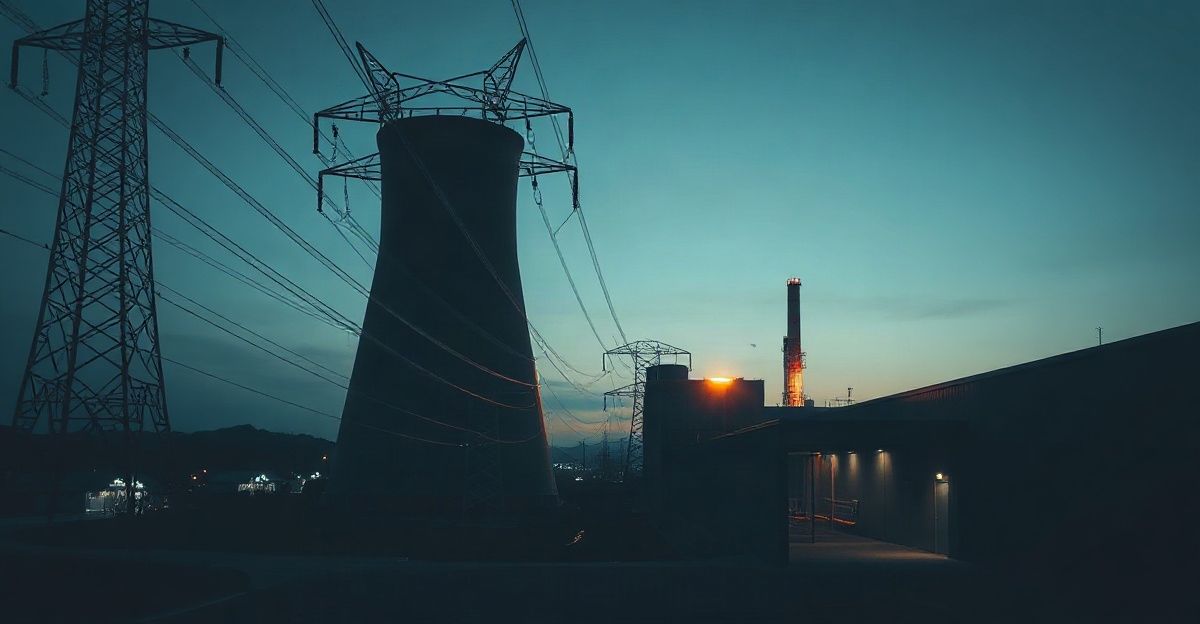

In the sixteen days from September 30 to October 15, 2026, the biggest AI infrastructure announcements were power contracts, not chip orders. Amazon signed for 690 MW of nuclear output in Maryland, Google for 890 MW of new nuclear capacity plus 2,700 MW from existing plants, AEP for a 702 MW fuel cell plant built for Google, and Venture Global for up to 16 gas-fired power islands of 720 MW each. The companies that can deliver megawatts on a known date now decide where AI capacity gets built. This roundup covers who they are, what they actually sell, and how quickly each option can deliver.
Why power companies became AI vendors
A GPU cluster is useless without a grid connection, and in most US markets that connection now takes longer than the building. The power and water analysis on ctaio.dev covers the demand side: IEA figures of roughly 485 TWh of data center consumption in 2025, heading toward about 950 TWh by 2030. The supply side is the subject of this guide. Three things changed in 2026:
- Hyperscalers stopped buying only renewable certificates and started paying for firm capacity. The 2026 nuclear contracts run 15 to 20 years and fund specific uprates or restarts.
- On-site generation went mainstream. Fuel cells and gas turbines next to the data hall are now standard proposals, not edge cases.
- Financing moved to debt. Contracted cash flows from hyperscalers make power plants and data centers easy to lend against, which is why the frame agreements keep getting larger.
The deals that defined September and October 2026
| Date | Buyer | Supplier | What was signed | When it delivers |
|---|---|---|---|---|
| Sep 30 | Amazon | Constellation | 20-year PPA for 690 MW from Calvert Cliffs (Maryland), including a ~190 MW uprate; more than $3B of investment | Uprate online 2030–2032 |
| Oct 6 | Constellation | 20-year deal for 890 MW of new nuclear capacity on PJM from $4.3B+ of upgrades at 11 units; separate 15-year deal for 2,700 MW from existing plants | First uprates roughly two years out | |
| Oct 14 | AEP with Bloom Energy | ~$4B, 702 MW fuel cell plant near Cheyenne, Wyoming, 20-year PPA | Full operation targeted end of 2028 | |
| Oct 15 | Venture Global (for data center tenants) | GE Vernova, Baker Hughes | Frame agreements for up to 16 combined-cycle power islands of 720 MW (~11.5 GW), sized for up to 10 GW of compute | Deliveries 2028–2034; first order expected by end of 2026 |
Read the right-hand column before the headline numbers. Every one of these contracts delivers most of its capacity after 2028. The market is booking the next decade's power, not this year's.
Nuclear operators: the fastest firm, low-carbon option
Existing reactors are the only large, carbon-free, around-the-clock source a data center can contract today. The operators that own them have become the most sought-after suppliers in the market.
Constellation Energy
The largest US nuclear fleet and the counterparty on three of the defining hyperscaler deals: Microsoft's 20-year contract that enabled the Three Mile Island Unit 1 restart (2024), Amazon's Calvert Cliffs agreement (September 30, 2026), and Google's 890 MW uprate program (October 6, 2026). Google's head of data center energy, Amanda Peterson Corio, summed up the logic: the fastest new megawatt is often the one existing infrastructure can provide. Constellation also signed a five-year contract to use Google Cloud and Gemini Enterprise for outage management and dispatch, which shows how closely the two sides now work together.
Vistra
Meta's main nuclear supplier. In January 2026 Meta signed 20-year PPAs for 2,176 MW from Vistra's Perry and Davis-Besse plants in Ohio, plus 433 MW of uprates at those plants and Beaver Valley that phase in through 2034. Deliveries under the PPAs start in late 2026, which makes this one of the few large contracts with near-term power.
NextEra Energy
NextEra is restarting the Duane Arnold reactor in Iowa for Google. Restarts are rare, because few retired plants are in a condition to come back. When one can, it is the quickest way to add new firm capacity to the grid.
Verdict: if you need clean firm power on a 2028–2032 horizon, the operators with uprate headroom are where to go. Ask whether a contract funds new megawatts (uprate or restart) or just reassigns existing output. Only the first adds supply.
SMR and advanced nuclear developers: the 2030s bet
Small modular reactor companies attract the most attention and the fewest megawatts this decade. Every hyperscaler has at least one SMR relationship, and every one of those contracts delivers in the 2030s.
| Developer | Hyperscaler relationship | Technology | Horizon |
|---|---|---|---|
| TerraPower | Meta: rights to two Natrium units plus up to six more (Jan 2026) | 345 MW sodium fast reactor with molten-salt storage (boost to 500 MW) | Up to 2.8 GW by 2035 |
| Oklo | Meta: campus in Pike County, Ohio (Jan 2026) | Small fast reactors | Early-to-mid 2030s |
| Kairos Power | Google: fleet agreement (2024) | Fluoride salt-cooled high-temperature reactor | First unit around 2030, fleet to 2035 |
| X-energy | Amazon: investment and deployment partnership (2024); raised $700M in Nov 2025 | Xe-100 high-temperature gas reactor | Early 2030s |
Capital keeps arriving. Valar Atomics reportedly raised $1 billion in August 2026 to mass-produce small reactors, and Bluecore Energy raised $50 million in September for barge-mounted units. For a technical review of which designs are closest to a licence, see ctaio.dev's nuclear microreactors for AI data centers, whose conclusion stands: none of them will power a production cluster you are planning for 2027.
Gas turbine makers and integrators: where near-term megawatts come from
For capacity before 2030, natural gas is the default, and the constraint is how many turbines the factories can build. Three manufacturers dominate large frame turbines: GE Vernova, Siemens Energy and Mitsubishi Power. Baker Hughes supplies turbines, compressors and the controls that integrate a power island.
The Venture Global agreement of October 15 shows the timelines. Its frame deals with GE Vernova and Baker Hughes cover up to 16 units of 720 MW with deliveries from 2028 to 2034, a manufacturing reservation for eight units, and a first firm order expected before the end of 2026. Venture Global's existing platform is six power islands, about 4.5 GW, that are ordered, under construction or operating. The pitch to data center tenants is grid independence: no new load on the public grid or public water.
Verdict: gas is the most scalable near-term option, but most turbine capacity for 2027–2028 is already reserved. A provider promising new gas-fired capacity should be able to show a turbine slot, not just a site.
Fuel cells and modular generators: the fastest on-site option
Bloom Energy
Bloom's solid-oxide fuel cells are modular, can be installed in phases and avoid the turbine queue, which has made Bloom the breakout power vendor of 2026. Three data points:
- AEP for Google (Oct 14, 2026): a ~$4B, 702 MW plant near Cheyenne under a 20-year PPA, construction starting in 2026, full operation targeted for the end of 2028, drawing on an earlier AEP agreement for up to 1 GW of Bloom systems.
- Oracle Project Jupiter: up to 2.45 GW of Bloom capacity proposed for Oracle's New Mexico campus, replacing an earlier turbine-and-diesel design.
- Brookfield: a partnership framework for on-site data center power expanded from $5B to $25B in mid-2026.
Mainspring Energy
Mainspring builds linear generators that run on natural gas, hydrogen or blends. In the same October announcement, AEP disclosed 190 MW of Mainspring units under an agreement for up to 1.6 GW through 2034. It is a smaller vendor than Bloom, but it is now in utility procurement for data center load.
Verdict: fuel cells cost more per megawatt-hour than grid power but can be energized years sooner. For a data center whose revenue depends on getting GPUs online by a given date, paying more for earlier power is often the right trade.
Utilities: from grid operator to dedicated developer
AEP's Wyoming project shows a newer model: a regulated utility group building generation for one customer through a separate entity (AEP holds about 92% of Cheyenne Fuel Cell, LLC). Utilities have been criticized for passing data center costs on to residential customers, and several 2026 structures respond to that. Oracle's Wisconsin arrangement reportedly shifts about $300 million of energy costs away from utility customers. Expect cost-protection clauses in every large tariff negotiation from now on.
How the options compare
| Option | Typical time to power | Scale per project | Carbon profile | Main constraint |
|---|---|---|---|---|
| Existing nuclear (contract) | Immediate to 2 years | Hundreds of MW to GW | Near zero | Reassigns supply unless paired with uprates |
| Nuclear uprate or restart | 2–6 years | 100–900 MW | Near zero | Limited number of suitable plants |
| Gas turbines (on-site or adjacent) | 2–4 years | Hundreds of MW to multiple GW | Fossil (carbon capture optional) | Turbine delivery slots, gas pipeline capacity |
| Fuel cells | 1–3 years, phased | Tens of MW to ~2 GW | Natural gas today, lower local emissions | Cost per MWh, fuel supply |
| SMRs / advanced nuclear | 2030s | 50–500 MW per unit | Near zero | Licensing, first-of-a-kind construction risk |
Time-to-power ranges are our editorial synthesis from the delivery dates in the contracts above, not vendor guarantees.
What this means if you buy compute rather than build it
Most companies will never sign a PPA. They buy capacity from a cloud, a neocloud or a colocation provider, and the power question reaches them as availability and price. Ask suppliers for the energization date of the hall your capacity sits in, whether that power is grid or on-site, and what the contract says if a grid upgrade slips. The AI FinOps guide covers the cost side. Power on a known date is now part of what you are buying.
Sources
- Constellation Energy, Constellation and Amazon announce 20-year PPA at Calvert Cliffs (Sep 30, 2026).
- SiliconANGLE, Google commits to 890 MW from Constellation (Oct 6, 2026).
- DatacenterDynamics, Google signs 20-year PPA with AEP for 702 MW fuel cell project; POWER, AEP plans $4B fuel cell plant, Mainspring deal (Oct 2026).
- Venture Global, frame agreement press release (Form 8-K) (Oct 15, 2026).
- World Nuclear News, Meta announces agreements with Vistra, TerraPower and Oklo (Jan 2026).
- POWER Engineering, Brookfield and Bloom expand to $25B framework.
Related reading: data center cooling companies 2026, neocloud GPU providers 2026, AI FinOps & GPU cost management, and the first-person view from Thomas Prommer on what four weeks of AI investment actually bought.
Which companies supply power to AI data centers?
Four groups. Nuclear operators such as Constellation, Vistra and NextEra sell output from existing plants and uprates under 20-year contracts. Gas turbine makers (GE Vernova, Siemens Energy, Mitsubishi Power) and integrators like Baker Hughes supply on-site plants. Fuel cell suppliers, led by Bloom Energy, offer faster modular capacity. Utilities such as AEP increasingly build dedicated generation for a single hyperscaler. SMR developers (Kairos, X-energy, TerraPower, Oklo) hold contracts for the 2030s.
Are nuclear power deals for data centers actually adding new power?
Some are. The 2026 Constellation deals with Google and Amazon pay for uprates, which are upgrades that raise the output of existing reactors: 890 MW of new capacity for Google across 11 units, and about 190 MW at Calvert Cliffs for Amazon. Restarts such as Three Mile Island (Microsoft) and Duane Arnold (Google) bring back retired capacity. Contracts for plain existing output add nothing to the grid. They reassign power that other customers were already using.
When will small modular reactors power AI data centers?
Not this decade at meaningful scale. Meta's TerraPower agreement targets generation by 2035 and its Vistra uprates phase in through 2034. Google's Kairos agreement and Amazon's X-energy partnership also run into the 2030s. Plan SMRs as a 2030s hedge, not as capacity for a cluster you are building in 2027.
Why are data centers using fuel cells and gas turbines?
Because grid connections take years and on-site generation can be built faster. AEP's 702 MW Bloom fuel cell plant for Google in Wyoming targets full operation by the end of 2028, and Oracle has proposed up to 2.45 GW of Bloom fuel cells for its New Mexico campus. Gas turbines are the bigger lever but face long delivery queues: Venture Global's frame agreement for 16 power islands schedules deliveries from 2028 to 2034.
What should a company buying AI compute ask about power?
Ask the colocation or cloud provider four things. Is the power energized today or contracted for later, and when? Is it grid, on-site, or both? What happens to your capacity if a grid upgrade slips? And who pays for any new generation, since several 2026 deals include utility cost-shift protections. A provider that cannot answer with dates is selling a forecast.
Ready to Find the Right AI Tools?
Browse our data-driven rankings to find the best AI tools for your team.